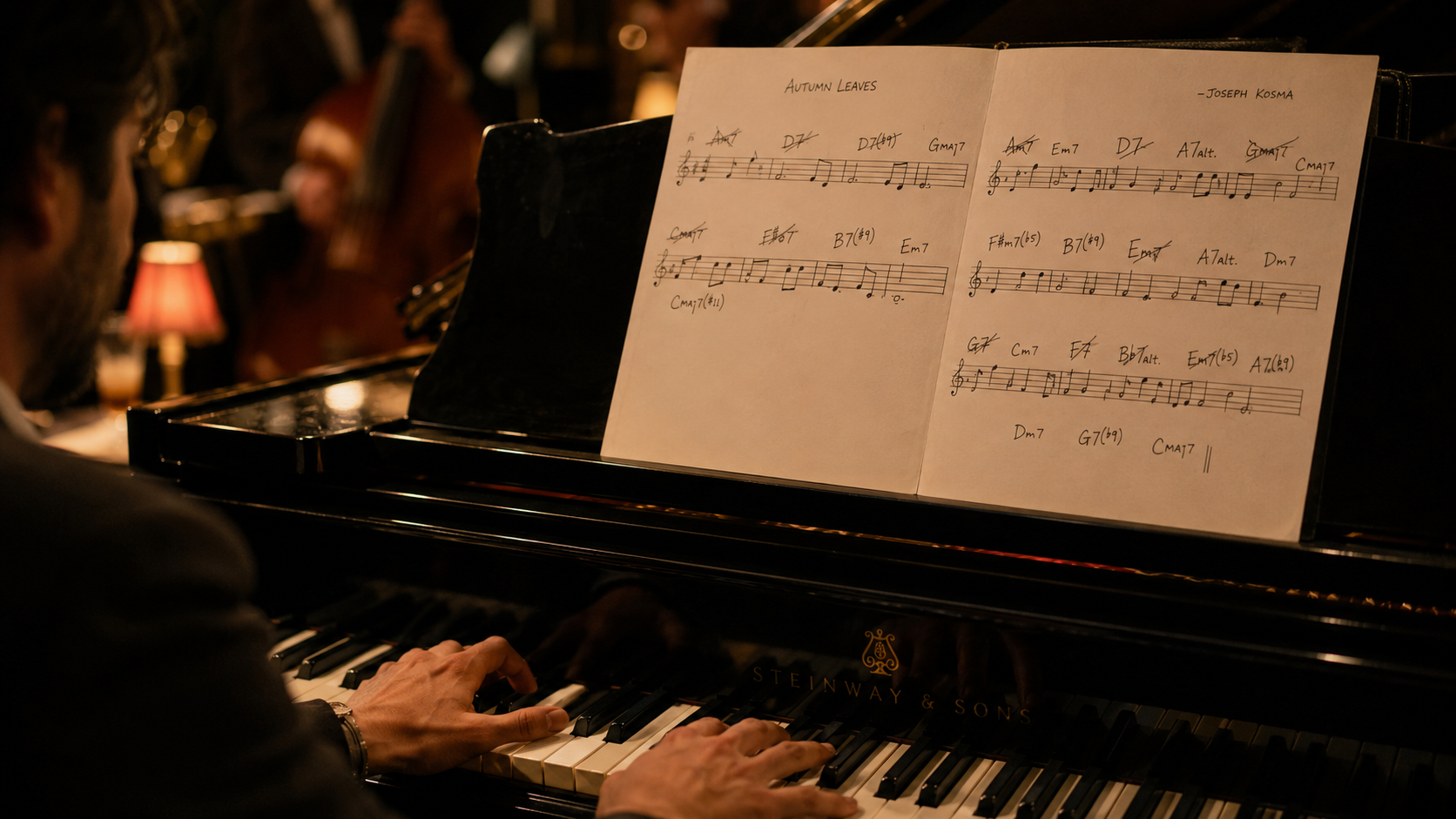
One of the quiet thrills of jazz is hearing a familiar tune turned strange and beautiful. A pianist sits down to play a song everyone in the room knows, and yet under the same old melody something unexpected is happening. The chords are not the ones on the lead sheet. The harmony shifts in places it never used to, colors the melody in shades it never had, and somehow the tune sounds both completely new and entirely itself. This is reharmonization, the art of replacing the chords beneath a melody while leaving the melody intact, and it is one of the most powerful tools a jazz musician can develop.
The first principle to understand is also the most liberating: the melody is sacred, but the harmony is not. A given melody note does not belong to only one chord. The note C can sit comfortably on top of a C major chord, but it is equally at home over an A minor seventh, an F major seventh, an F minor, a D minor, an A flat major seventh, and many others. Each of those chords casts the same C in a different light, making it sound resolved, or yearning, or dark, or luminous. Reharmonization exploits exactly this freedom. As long as the new chord contains, or at least gracefully accommodates, the melody note sounding above it, you are free to swap the original harmony for something else entirely. The melody is the fixed point around which everything else can move.
The simplest entry into this art is functional substitution, replacing a chord with another that does the same harmonic job. In tonal music, chords fall into rough families based on their function: some feel like home, some feel like tension pulling toward home, some sit in between. Because chords within a family share notes and a similar pull, one can often stand in for another. A tonic chord can be replaced by its relative minor, since the two share most of their notes and the melody usually sits happily on both. Swapping these family members in and out is a gentle reharmonization that subtly recolors a passage without disrupting its underlying logic, and it is where most players begin.
From there, the single most characteristic move in all of jazz reharmonization is the tritone substitution. The idea sounds technical but the effect is instantly recognizable as the sound of jazz. Any dominant seventh chord, the tense chord that wants to resolve, can be replaced by another dominant seventh whose root lies a tritone away. The reason this works is elegant: the two chords share the same crucial pair of notes, the third and seventh, which are what give a dominant chord its character and its pull. Because that essential tension is preserved, the substitute resolves just as convincingly, but it does so while sliding the bass down by a half step, creating a smooth chromatic descent that is one of the most satisfying sounds in the music. A standard turnaround transformed by tritone subs suddenly feels sleek and sophisticated, all without touching a note of the tune.
Another rich source of new color is borrowing chords from outside the key, often called modal interchange. A song in a major key can borrow chords from its parallel minor, importing a touch of melancholy or weight that the bright major scale cannot provide on its own. A minor four chord substituted for the expected major four is a classic, bittersweet sound, and again, because the melody note usually still fits, the listener hears only a deepening of mood, not a wrong note. Reharmonizers also love to insert secondary dominants, temporary tension chords that briefly point toward a chord other than the home key, creating little moments of forward motion and surprise that propel the harmony along.
A more dramatic technique is to rebuild the path between two points entirely. Jazz harmony loves the two-five-one progression, the gravitational backbone of the style, and a skilled reharmonizer can insert chains of these progressions to approach a target chord from a fresh direction, or use a cycle of dominant chords to wind the harmony through unexpected territory before arriving exactly where it needed to be all along. The melody stays put while the road beneath it is completely redrawn. Underpinning many of these moves is the humble pedal point, holding a single bass note steady while the chords above it shift, which lets a reharmonizer pile up tension and surprising colors that all resolve when the bass finally moves.
For all these techniques, one discipline keeps reharmonization from collapsing into chaos: every choice must answer to the melody and to the ear. The constant question is whether the melody note still sounds good against the new chord, whether it becomes a rich extension like a ninth or a thirteenth, or whether it clashes in a way that feels like a mistake rather than a deliberate color. Good reharmonization is not about cramming in as many fancy substitutions as possible. It is about taste, about knowing when a surprising chord illuminates the melody and when it merely distracts from it. The most beautiful reharmonizations often use just one or two well-placed substitutions to transform the emotional character of a phrase.
In the end, reharmonization is where a jazz musician stops being an interpreter and becomes, for a moment, a composer. The standard provides the melody, the shared text everyone recognizes, and the player provides a new harmonic world for it to live in. It is a conversation across time between the songwriter who set the tune and the musician reimagining it tonight. Master this craft and you gain the ability to make any song your own, to find the hidden emotional possibilities sleeping inside the most worn-out standard, and to give a room full of people the particular joy of hearing something they know by heart sound, for a few minutes, like they are hearing it for the very first time.
